Maximilian Dax Honored with Hector Stiftung-Award and Otto Hahn Medal
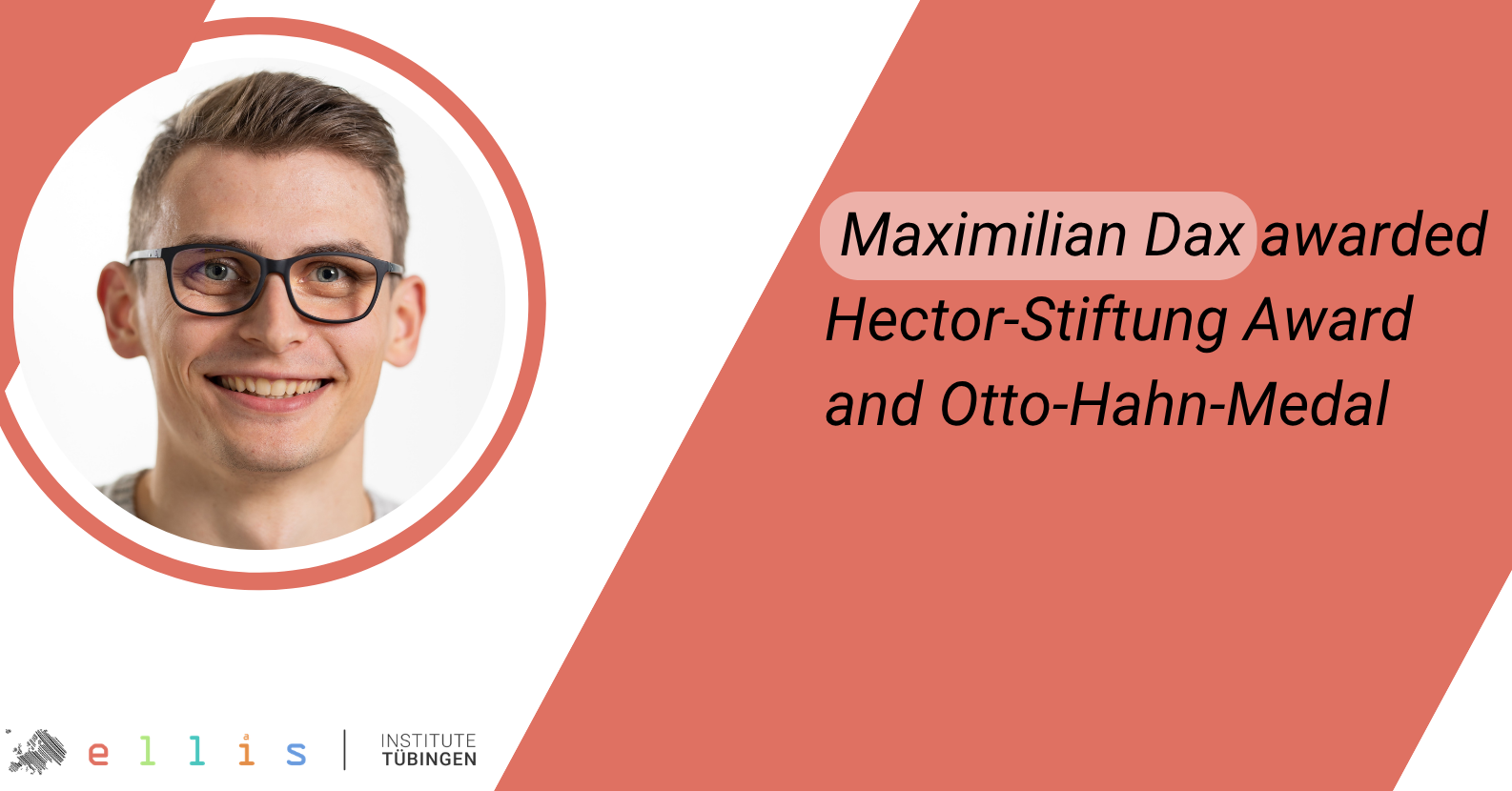

Dr. Maximilian Dax has received two major distinctions for his research at the intersection of machine learning and astrophysics: the Hector Stiftung-Award 2026 from the Heidelberger Akademie der Wissenschaften and the prestigious Otto-Hahn-Medal 2025 from the Max-Planck-Society.
The Max Planck Society honors Max with the Otto-Hahn-Medal, awarded annually to outstanding early-career researchers for exceptional scientific achievements connected to their doctoral work. In his PhD at the Max Planck Institute for Intelligent Systems, Max developed an AI framework for gravitational-wave data analysis, which has addressed critical computational bottlenecks in the field and contributed to high-profile astrophysical discoveries.
Max’ work has been published in leading scientific venues, including Nature, Physical Review Letters, and top machine learning conferences. His AI methods are deployed within the international LIGO-Virgo-KAGRA collaboration.
The Hector Stiftung-Preis recognizes outstanding young researchers in computer science and honors Max’ groundbreaking work in gravitational-wave astronomy. This research focuses on merging neutron stars: extreme cosmic events that emit both gravitational waves and electromagnetic radiation. Observing these events in real time offers enormous scientific potential, but it requires the rapid analysis of highly complex data.
Together with collaborators, Max developed DINGO-BNS (Deep Inference for Gravitational-wave Observations from Binary Neutron Stars), a machine-learning framework capable of estimating the location and physical properties of merging neutron stars in just one second. This is a dramatic improvement over traditional approaches that can take up to 30 minutes.
Following his PhD defense in 2025 and a postdoctoral stay at ETH Zurich, Max returned to Tübingen as Principal Investigator at the ELLIS Institute and independent research group leader at the Max Planck Institute for Intelligent Systems, where his SPIN (Science and Probabilistic Intelligence) group develops AI methods for scientific discovery.
Congratulations to Max Dax on these well-deserved recognitions and on advancing the frontiers of AI-driven science.
Find out more about his research.
Read the Max-Planck-Society's news here.
Read Max’s award-winning papers here:
[1] Real-Time Gravitational Wave Science with Neural Posterior Estimation
[2] Neural Importance Sampling for Rapid and Reliable Gravitational-Wave Inference
[3] Real-time inference for binary neutron star mergers using machine learning